
We live in a binary world restricted to a binary style of logic. There is no wiggle room to expand beyond this boundary.
This restricts us to an extremely limited, analytical procedure when applying the Conservation of Energy to energetic processes at any particular point in time.

A continuation of:
Conservation of Energy upholds the arrow of time. Thus, its analysis of energetic interactions must uphold the view that every causation results in an effect. Hence, there is no wiggle room with regard to this binary, dualistic, scheme of perception (and the organization of knowledge) in which effects follow from causes.
Given this framework, Conservation of Energy merely concerns itself with two references, two points of view, during each comparative analysis of an accountability ledger. It does not, nor can it, account for more than two comparative references at the same time, because these two references are the dualistic perspectives of causation and resultant. This is why Conservation cannot be applied to a multi-point-of-view set of references occurring simultaneously without undermining the whole purpose behind Conservation is to uphold the arrow of time. If we keep this purpose uppermost in our mind, and refrain from any other distraction (for it will be extraneous to our analysis), then we’ll be able to handle any anomaly or convention that we wish to analyze and never find ourselves at risk of violating some, or another, principle of physics.
This is why engineers prefer to avoid anomalies since their subscription to a particular flavor of religious interpretation of Conservation (which has been very popular for more than a century) erroneously demands that this analysis be broadcast across the entire Universe across all of its individually, referenced points of view in a simultaneous manner.
That’s a robust hypothesis, yet the experience of engineers has never validated that hypothesis. But they continue to proclaim the simultaneous pervasiveness of their belief as if it were truth.
So, if a battery drops its storage of voltage by converting some of it into a flow of current which impacts a resistor, and that resistor becomes excited with heat, then this consideration is a comparative analysis of how Conservation applies to the causation versus the resultant, namely: current causing heat to manifest in the resistor due to its application against the resistor.
If this were a bidirectional exchange occurring simultaneously, then we’d analyze both directions, simultaneously. But it is not. It has one cause and one effect in which current causes a resultant of heat. We cannot swap the effect in place of its causation while also swapping the causation in place of its effect. They are not capable of bidirectional substitution.
This is as far as the analysis of the Conservation of Energy can, or could, proceed at any one point in time, because we are not analyzing the flow of current engaging all matter across the vastness of the Cosmos to see whether or not all of that Universal matter is heating up and by what amount. Nor are we analyzing some sort of bidirectional heating is taking place with heat translating into current while at the same time current is translating into heat and all of this taking place involving multiple vectors at the same time. Instead, we break down any such complexity and analyze merely one action between its causation and its resulting effect. That’s it.
That’s the limitation to which Conservation of Energy is restricted to.
To generalize from these particulars that Conservation is any more robust than this is a lie.
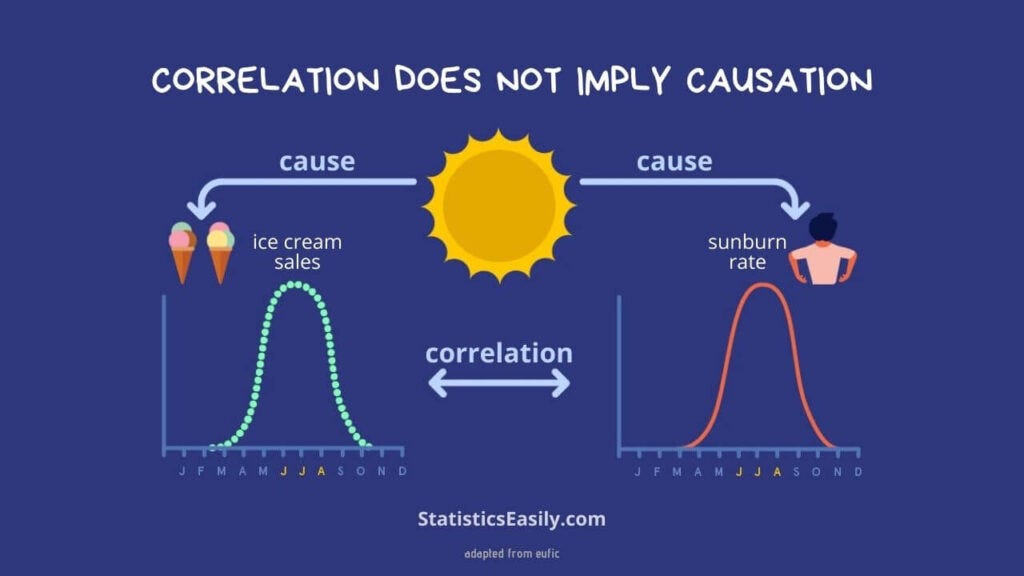
A basic review of correlation versus causation when analyzing statistics : (reddit) r/CompetitiveTFT
This is a good example of how a real input of power can have a vastly different outcome if a parametric pumping acts upon the input in such a way so as to amplify its reactance beyond the real-valued input. But this is due to the factors of reactance acting upon the amplitude of the input, namely: how frequency modification, capacitive modification, and inductive modification can alter the quantity of how much work can a fixed input of real power accomplish.
Conservation of Energy demands a straightforward presumption that a fixed quantity of input will always, and without fail, accomplish the same quantity of work. But reactance gets in the way of this presumption whenever parametric pumping gets involved.
Thus, input power does not always result in the same quantity of work, because input power may not always be the direct cause of the quantity of work which results from that input if parametric pumping complicates the analysis. Instead, and in the presence of any intermediary step of parametric pumping, any input of power is correlational to any accomplishment of work without direct causation becoming involved.
This is how corollaries can be confused with causes.